WebCrim is a trusted online criminal court record search system that helps the public locate case information from participating New York courts. The platform allows searches by Case Identifier or defendant name, making it easier to find scheduled court appearances, case status, criminal charges, and assigned court locations. Attorneys, defendants, family members, journalists, and researchers frequently use the service to check publicly available court records. Since the information comes from the New York State court system, it serves as a reliable source for current criminal case updates. The system saves time by reducing the need to contact the courthouse for routine case information. It supports quick record searches while keeping restricted or sealed cases protected under state law.
WebCrim provides a practical way to review criminal court activity before attending a hearing or following the progress of a case. Each criminal matter receives a unique Case Identifier, which helps return more accurate search results than using a name alone. Users can view available details such as hearing dates, courtroom assignments, judges, case history, and disposition information when those records are publicly available. Court staff update records as new filings and hearings take place, so case information changes throughout the legal process. The platform supports transparency by making eligible criminal court records easier to locate for the public. Whether checking a pending case or confirming a future court appearance, WebCrim remains one of the primary online resources for New York criminal court record searches.
How to Search by Case Identifier
The Case Identifier Search is available through the official WebCrims portal maintained by the New York State Unified Court System. This search option is intended for criminal court cases and works best when the exact case number is available. After a successful search, users may view available information such as the current case status, court location, hearing dates, judge assignment, charges, and case history, depending on the court and record availability. Public records displayed by WebCrims do not include sealed or confidential cases.
Information Needed Before You Begin
Before opening the search page, gather the correct case information from an official court document. Entering the information exactly as issued by the court helps produce accurate results.
You should have:
- Case Identifier (Docket Number, Indictment Number, SCI Number, or other accepted case number)
- Court notice, summons, complaint, or other official court paperwork
- Internet connection and a supported web browser
- Basic knowledge of the court where the case was filed (if available)
Step for Search Process
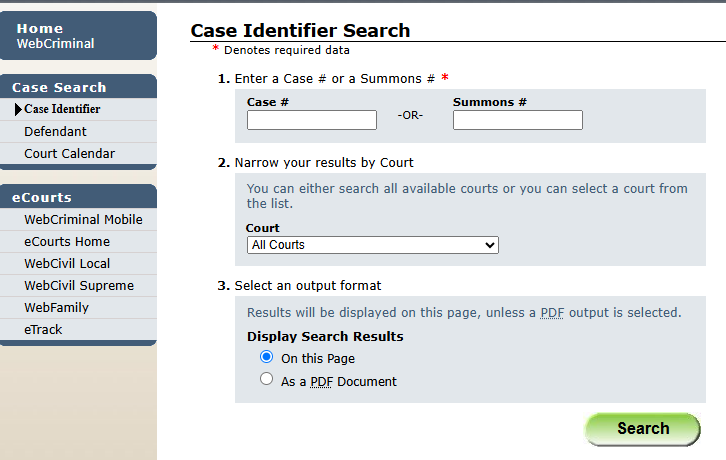
Searching by Case Identifier takes only a few minutes. Follow each step carefully to avoid search errors.
Open the Official WebCrims Website
Visit the official WebCrims portal provided by the New York State Unified Court System.
Official Case Identifier Search: https://iapps.courts.state.ny.us/webcrim_attorney/CaseIdyentifierSearch
Enter the Case Identifier
Type the complete Case Identifier exactly as it appears on your court paperwork.
Check for:
- Correct letters
- Correct numbers
- Hyphens
- Special characters
- No extra spaces
Select the Court (If Requested)
Some searches may ask users to choose the court where the criminal case was filed.
Examples include:
- Criminal Court
- County Court
- Supreme Court (Criminal Term)
Selecting the correct court helps narrow the search.
Submit the Search
Click the Search button after reviewing the entered information.
The system will process the request and look for a matching criminal court record.
Review the Search Results
If a matching public record is found, WebCrims may display:
| Information Available | Description |
|---|---|
| Case Status | Current stage of the criminal case |
| Court Name | Court handling the case |
| Court Part | Assigned courtroom or court part |
| Judge | Assigned judge |
| Charges | Criminal offenses filed |
| Hearing Dates | Future court appearances |
| Appearance History | Previous court dates |
| Defendant Information | Basic case participant details |
| Disposition | Final court outcome, when available |
Check for Updates Later
Court records change as hearings take place and court staff enter new information. If recent activity does not appear, search again later.
Search Errors and Solutions
Most search problems are caused by incorrect information entered into the search form. Reviewing the details usually fixes the issue within minutes.
| Search Problem | Possible Cause | Solution |
|---|---|---|
| No records found | Incorrect Case Identifier | Compare the number with the official court document. |
| Wrong case displayed | Mistyped number | Verify every letter and number before searching again. |
| Invalid search | Missing characters | Enter the complete identifier without leaving out letters or digits. |
| Recent hearing missing | Court record has not been updated | Wait until the court updates the record and search again. |
| Too many results | Incorrect search method | Use the exact Case Identifier instead of a name search. |
Types of Case Identifiers Accepted
Different New York criminal courts may use different case numbering formats. WebCrims accepts eligible case identifiers issued by participating courts, provided they are entered exactly as shown on official court documents. Using the correct format improves search accuracy and reduces failed searches. The identifier can usually be found on court notices, criminal complaints, summonses, or paperwork received from the court or an attorney.
Docket Number
A Docket Number is one of the most common case identifiers used in criminal courts. It is assigned when a criminal matter is officially entered into the court system. Users who have a docket number can usually locate their case directly without searching by name.
Indictment Number
An Indictment Number is assigned after a grand jury files formal criminal charges in felony cases. This number identifies the indictment connected to a specific defendant and criminal proceeding. It helps attorneys, prosecutors, and defendants locate felony case records accurately.
Superior Court Information (SCI) Number
A Superior Court Information (SCI) Number is issued when a felony case proceeds without a grand jury indictment. Instead, the defendant waives indictment and the prosecution files a Superior Court Information. Cases using an SCI Number can be searched when they are included in participating court records.
Local Criminal Court Case Number
Some criminal matters begin in local criminal courts before moving through the court system. These cases receive a Local Criminal Court Case Number, which serves as the official identifier during the early stages of the case.
This number can often be found on appearance tickets, complaints, or court notices.
Who Can Use the Search Tool?
The WebCrims Case Identifier Search is available to anyone searching eligible public criminal court records from participating New York courts. No legal training or special account is required for a basic search.
The search tool is commonly used by:
- Attorneys
- Defendants
- Family members
- Court staff
- Journalists
- Researchers
- Members of the public
The system displays only publicly available criminal court information. Sealed records, confidential proceedings, and cases protected by law are excluded from public search results.
What You Can Find in Search Results
Once a matching case is located, WebCrims displays information that helps users follow the progress of a criminal court matter. The search results bring together important case details in one place, making it easier to check scheduled hearings, court assignments, criminal charges, and the current status of a case. Some records may contain more information than others, depending on how the court maintains its public records. Cases that are sealed or protected by law will not appear in the public search results.
Case Status and Court Information
One of the first sections shown in the search results is the current Case Status. This tells users where the criminal case stands within the court process. The results may include information about the court responsible for handling the case, the assigned judge, courtroom, and upcoming court dates. Reviewing this information helps defendants, attorneys, and family members prepare for future appearances.
Court information commonly displayed includes:
Defendant and Charge Details
Search results may include basic information about the defendant together with the criminal charges filed in the case. This section helps users confirm that they have located the correct record. The amount of personal information displayed is limited to public court records. Sensitive information and protected records are excluded from public view.
Defendant and charge details may include:
- Defendant name
- Case Identifier
- Criminal charge descriptions
- Charge level, when available
- Filing information
- Case reference details
These records help users identify the case without exposing confidential information protected under New York law.
Hearings, Appearances, and Case Outcomes
WebCrims may display both upcoming and previous court appearances connected to the criminal case. This allows users to follow the progress of court proceedings from the first appearance through the final outcome.
When available, the search results may include hearing dates, appearance history, adjournments, and the final disposition entered by the court. Users checking their case regularly can see new updates after court staff record recent hearings.
Case activity may include:
- Scheduled hearing dates
- Previous court appearances
- Adjourned hearing information
- Court calendar updates
- Case disposition or final outcome
- Sentencing information, when publicly available
- Other case history entered into the court record
Search Coverage and Availability
WebCrims brings together criminal court information from many participating courts across New York State. It helps users check eligible criminal case records without visiting the courthouse. Since each court manages its own records, the amount of information available may vary. Some cases appear immediately after court staff update them, while others may take longer or remain unavailable if they are protected by law.
Counties Included in WebCrims
WebCrims supports criminal case searches in many counties throughout New York. The system includes the five New York City boroughs along with numerous counties across the state, making it a central place to search public criminal court records.
Some of the most commonly searched counties include:
- Albany County
- Bronx County
- Broome County
- Erie County
- Kings County (Brooklyn)
- Monroe County
- Nassau County
- New York County (Manhattan)
- Onondaga County
- Oneida County
- Orange County
- Queens County
- Richmond County (Staten Island)
- Rockland County
- Suffolk County
- Westchester County
Many additional counties participate in the WebCrims system. If a county record cannot be located, it may be handled by a court that does not publish records through WebCrims, or the case may not be be available for public viewing.
Courts and Case Types Covered
WebCrims focuses on criminal court matters rather than every court record maintained in New York. Users searching for civil lawsuits, family matters, or probate records will need to use a different court search system.
The platform commonly includes criminal cases handled by Criminal Court, County Court, Supreme Court (Criminal Term), District Court, and City Court with criminal jurisdiction. Eligible misdemeanor cases, felony cases, pending proceedings, scheduled appearances, and many completed criminal cases can often be searched through WebCrims. Records that are sealed, confidential, or restricted by law are excluded from public search results.
How Often Records Are Updated
Court records are updated after new information is entered by participating courts. Changes may appear after hearings, judicial decisions, new filings, adjournments, or final case dispositions. Since every courthouse follows its own internal workflow, update times are not identical across New York.
Users should not expect every court action to appear immediately after it occurs. If recent case activity is missing, waiting until the next court business day often resolves the issue. When information still does not appear after a reasonable period, reviewing the Case Identifier or contacting the court clerk is the best next step. Checking the record periodically helps users stay informed about new hearing dates, case status changes, and other public criminal court updates without making unnecessary trips to the courthouse.
Benefits and Limitations of the Search
The Case Identifier Search helps users locate specific criminal court records without sorting through unrelated results. Since each case receives a unique number, this search method reduces confusion and improves accuracy. WebCrims provides valuable court details for eligible public records, but users should know that it does not display every criminal matter or every piece of case information. Availability depends on court participation, record status, and New York public access rules.
Benefits of Using a Case Identifier
A Case Identifier provides a direct way to find a specific criminal case in WebCrims. Unlike name searches that may show multiple matching records, a case number points to one court file.
Key benefits include:
- More accurate results: The unique number reduces the chance of selecting the wrong case.
- Faster searches: Users can locate records without reviewing multiple name matches.
- Easy case tracking: The identifier can be used to check future updates and court activity.
- Better record verification: Attorneys, defendants, and the public can confirm they are viewing the correct case.
- Convenient follow-up: The same number can be used for future searches related to that case.
Using a Case Identifier is especially helpful when checking hearing schedules, court locations, case status updates, and available criminal court information.
Limitations of WebCrims Records
Although WebCrims provides valuable criminal court information, the search system has certain limits. The platform only displays records that are available through participating courts and permitted for public viewing.
Some limitations include:
- Not every New York court case appears in WebCrims.
- Sealed and confidential records are not available.
- Recently filed information may take time to appear.
- Some case details may be limited depending on the court.
- Records from non-criminal matters require different court search systems.
Users should treat WebCrims as a public record search resource rather than a complete copy of every court document. For official copies, certified records, or additional case details, the appropriate court clerk may provide further assistance.
Privacy and Public Access Rules
WebCrims follows New York court rules regarding public access to criminal case information. Public records allow transparency while protecting information that requires legal confidentiality. Certain records remain restricted to protect privacy and legal rights. These may include sealed cases, confidential proceedings, juvenile matters, and other records protected under state law.
Public access rules help balance two needs:
- Allowing the public to view eligible criminal court information
- Protecting private information that should not be released
Users should only use available records for lawful purposes. The information shown through WebCrims reflects public court data and may change as courts update their records.
When a Case Identifier Is Unavailable
A missing Case Identifier does not always prevent users from finding a criminal court record. WebCrims offers other ways to search for eligible public case information, although these methods may require more details and careful review. The best option depends on what information the user already has, such as the defendant’s name, court location, or scheduled hearing date.
Search by Defendant Name
The defendant name search allows users to find criminal court records by entering the person’s name instead of a Case Identifier. This option is helpful when the official case number is unavailable or cannot be located. Name searches may return multiple results if different people have similar names. Users should review each matching record carefully and compare details such as the court location, charges, and case information before choosing the correct record.
Providing additional information can improve search accuracy, including:
- Full legal name of the defendant
- County where the case was filed
- Approximate court date
- Court location, if known
This method is useful for locating possible matches, but the Case Identifier remains the more precise search option.
Contact the Court Clerk
The court clerk can assist when online searches do not provide the expected results. Court clerks maintain official records and can help confirm basic case information or explain where a record can be requested. Users contacting the clerk should provide enough details to help locate the case. The clerk may confirm whether a case exists, identify the correct court, or provide instructions for obtaining further records. For official assistance, users may need information such as the defendant’s name, case location, or approximate date of the court activity.
Check the Court Calendar
Court calendar searches provide another option for finding upcoming criminal proceedings without a Case Identifier. This method is useful for users who need information about scheduled appearances or court activity. Calendar information can help confirm whether a hearing has been scheduled and where the proceeding will take place. The available details depend on the court and the type of case.
Court calendar records may include:
- Scheduled appearance dates
- Court part or courtroom details
- Judge assignment, when available
- Updates related to upcoming proceedings
If a calendar entry cannot be found online, contacting the court directly can provide the latest scheduling information.
Accurate Case Searches
A successful WebCrims search depends on entering the correct information and choosing the right search details. Small mistakes, such as a missing number or incorrect court selection, can prevent the system from finding a matching record. Before submitting a search, users should review the information carefully and confirm that it matches their official court documents.
Verify the Identifier Before Searching
A Case Identifier should be entered exactly as it appears on official court paperwork. Since the identifier connects directly to one criminal case, even a small typing error may lead to no results or an incorrect record.
Before searching, users should check the identifier for:
- Missing numbers or letters
- Incorrect spacing
- Wrong characters or symbols
- Extra characters added by mistake
Copying the Case Identifier directly from a court notice or legal document can reduce common entry errors. Users should avoid guessing the number when possible because similar-looking identifiers may belong to different cases.
Confirm the Correct Court and County
Selecting the correct court and county improves the chance of finding the intended record. Criminal cases are managed by different courts across New York, and each court maintains its own case information. A case filed in one county may not appear under another county search. Before starting a search, users should confirm where the criminal matter was filed by checking their court documents or notices.
The correct court information helps users:
- Locate the proper case record
- Avoid unrelated search results
- Find accurate hearing information
- Confirm the court handling the matter
Troubleshoot Missing or Incorrect Results
Sometimes a WebCrims search does not display the expected record. This does not always mean the case is unavailable. The issue may result from incorrect information, recent court activity, or record restrictions.
Users can try the following steps:
- Review the Case Identifier and correct any typing mistakes.
- Confirm that the selected court and county match the case location.
- Try searching again after checking official documents.
- Verify whether the record may be sealed or unavailable to the public.
- Contact the court clerk if the issue continues.
Recent filings or court updates may require time before appearing online. Checking the information carefully and using the correct search details usually helps users find available criminal court records more efficiently.
Frequently Asked Questions
WebCrims helps users find publicly available criminal court information from participating New York courts through online searches. Many users have questions about Case Identifier searches, available records, search requirements, and reasons why a case may not appear. The following frequently asked questions provide clear information about using WebCrims and finding eligible criminal court records.
How do I search a New York case using a case identifier?
To search a New York criminal case using a Case Identifier, users need to open the official WebCrims search page and select the Case Identifier Search option. The complete case number should be entered exactly as it appears on official court documents. After submitting the search, WebCrims checks the identifier and displays available public case information. The results may include case status, court location, hearing dates, charges, judge information, and other details available for public viewing. Using the correct identifier provides a more accurate result than searching by name alone.
What details are included in WebCrims search results?
WebCrims search results may show different types of criminal court information depending on the case and court records available. Users may find details such as the defendant name, Case Identifier, court location, charges, assigned judge, hearing schedules, case history, and final disposition information when available. The amount of information shown can vary between cases because courts maintain records differently. Public search results only include information allowed under New York court access rules. Sealed or confidential records are not displayed through WebCrims.
Can I search WebCrims without a case identifier?
Yes, users can search WebCrims without a Case Identifier by using a defendant name search. This option helps people locate possible criminal court records when they do not have the official case number. Since different people may have the same or similar names, the search can return multiple results. Users should compare details such as county, court location, charges, and case information before selecting a record. A Case Identifier remains the preferred option when it is available.
Why is my case not appearing in WebCrims?
A case may not appear in WebCrims because of incorrect search information, delayed updates, court coverage limits, or record restrictions. Users should first confirm that the Case Identifier or defendant name was entered correctly. Some criminal matters may not appear because they are sealed, confidential, or handled by a court outside the WebCrims system. Recently filed cases or new court activity may require time before appearing online. If the record remains unavailable, contacting the appropriate court clerk can help confirm the case status.
Which New York courts are included in WebCrims?
WebCrims includes criminal case records from many participating New York courts. The system covers criminal matters handled by courts such as Criminal Court, County Court, Supreme Court Criminal Term, District Court, and City Court with criminal jurisdiction. It includes many counties across New York State, including the five New York City boroughs and several counties outside the city. The availability of records depends on court participation and public access rules. Cases from courts or case types outside the WebCrims system may require different search methods.
Is the WebCrims Case Identifier Search free?
Yes, the WebCrims Case Identifier Search is free for users who want to check available public criminal court information online. No payment is required to perform a basic case search through the official system. Users can search eligible records without creating a paid account or visiting a courthouse. Charges may apply only when requesting official copies, certified documents, or additional services from the court. The free search option makes it easier for the public to review available criminal case information.